Wednesday, June 6, 2012

Cuban Tour: Day 2


Day 2 of our tour started off with a lecture, given by Miguel Coyula, a well known Cuban architect, urban planner, and professor at the University of Havana. Professor Coyula gave us a presentation about the architecture of Havana which was very interesting and informative, and at the same time, re-enforced José's mantra: "Cuba is complicated!" I found a good article on a site called "The Ethical Traveler," describing a tour of Havana that Coyula led last summer, explaining the dilemma Cuba, and Havana in particular, faces with the city crumbling and no money to maintain or restore it.
Although many buildings in Havana have been restored, more of them look like this residential area, with buildings being "condemned" everyday, and families moved to temporary housing.


After our lecture, we were shuttled over to Plaza de Armas, in Old Havana, where we wandered a bit, and had the opportunity to bargain with book vendors there. 
In the center of the square, there is a statue of Carlos Manuel de Cáspedes, a landowner and lawyer who, in 1868, freed his slaves and made the Grito de Yara, which declared Cuba's independence from Spain, and began the first of three liberation wars that Cuba fought against Spain. Cáspedes is known as The Founding Father of Cuba.
While walking between plazas, José pointed out the Hotel Ambos Mundos, where in Room 511, Ernest Hemingway is said to have written "For Whom the Bell Tolls."
Hotel Ambos Mundos Havana  
Walking the side streets of Havana, revealed many scenes like these...
Elementary school children (signified by the red uniform skirt or shorts) walking home.
Typical street musician as seen in almost any city in the world.
No matter where we go in the world, we always see weddings.
Tiny bride's maid running to catch up!
View of El Capitolio building, which is now the Cuban Academy of Sciences. 
Next stop was Plaza de la Catedral (Cathedral Square).
Cathedral of The Virgin Mary of the Immaculate Conception. 
Wandering around in this square was an interestingly dressed, bearded gentleman, in a beret, with a huge cigar, trying to get people to pay him to take a picture with him. 
He was really watching me, as I tried to surreptitiously get a shot of him with my telephoto lens. Needless to say, he was NOT happy with me!
We then had lunch at El Patio, a lovely restaurant in the same square.

We ate on the Spanish-style interior patio, with shade cloth overhead.
After lunch, we visited a craft fair in a gigantic warehouse, where hundreds of artists and crafts people had booths set up to sell their wares to tourists.
There were dozens of painters with canvases for sale. The paintings tended to be similar - colorful and a little schmaltzy, but occasionally, I came across something of interest. Unfortunately, we had very little time there, so other than a lovely pendant, and a few trinkets, I didn't buy much. José instructed us ahead of time not to pay asking prices, but rather to bargain with the sellers. I have to admit though, I found the prices to be so low, that I didn't have the heart to dicker over them! 

After the craft fair, we went to yet another town square called Plaza de San Francisco, and then to Plaza Viejo.
This statue in Plaza de San Francisco is of a well-known street person who was called El Caballero de Paris. People rub his beard for good luck.
Popular micro-brewery in Plaza Vieja
Modern sculpture in Plaza Vieja
Also on our walking tour, we stopped at Hostal Los Frailes, a small boutique hotel, that has an aljibe, a rainwater collection system from the 19th century. It looked like a lovely place to stay.


In keeping with the requirements of our special license to visit Cuba, there was kind of an educational reason behind our visit to the small hotel: to learn about the aljibe in its center. After a very long, and very warm day of walking the streets of Havana, we went to dinner at a popular open air restaurant called El Aljibe. I'm not sure why it is called that, but they are known for their special chicken recipe, which was very good. In fact, some say it's the best chicken in Havana! And apparently, the likes of Jack Nicholson, Jimmy Carter, and Danny Glover have dined there, too! 

Note: To view enlarged photos, just click on one of them and you will see a slide show of all photos in this post. Click the X in upper right hand corner of the slide show to return to the blog. Also, in case you hadn't noticed, any type within the post that is a different color than white, can be clicked on and it will link you to another webpage with more information.

Friday, June 1, 2012

Saturday, May 26, 2012

Transportation in Cuba

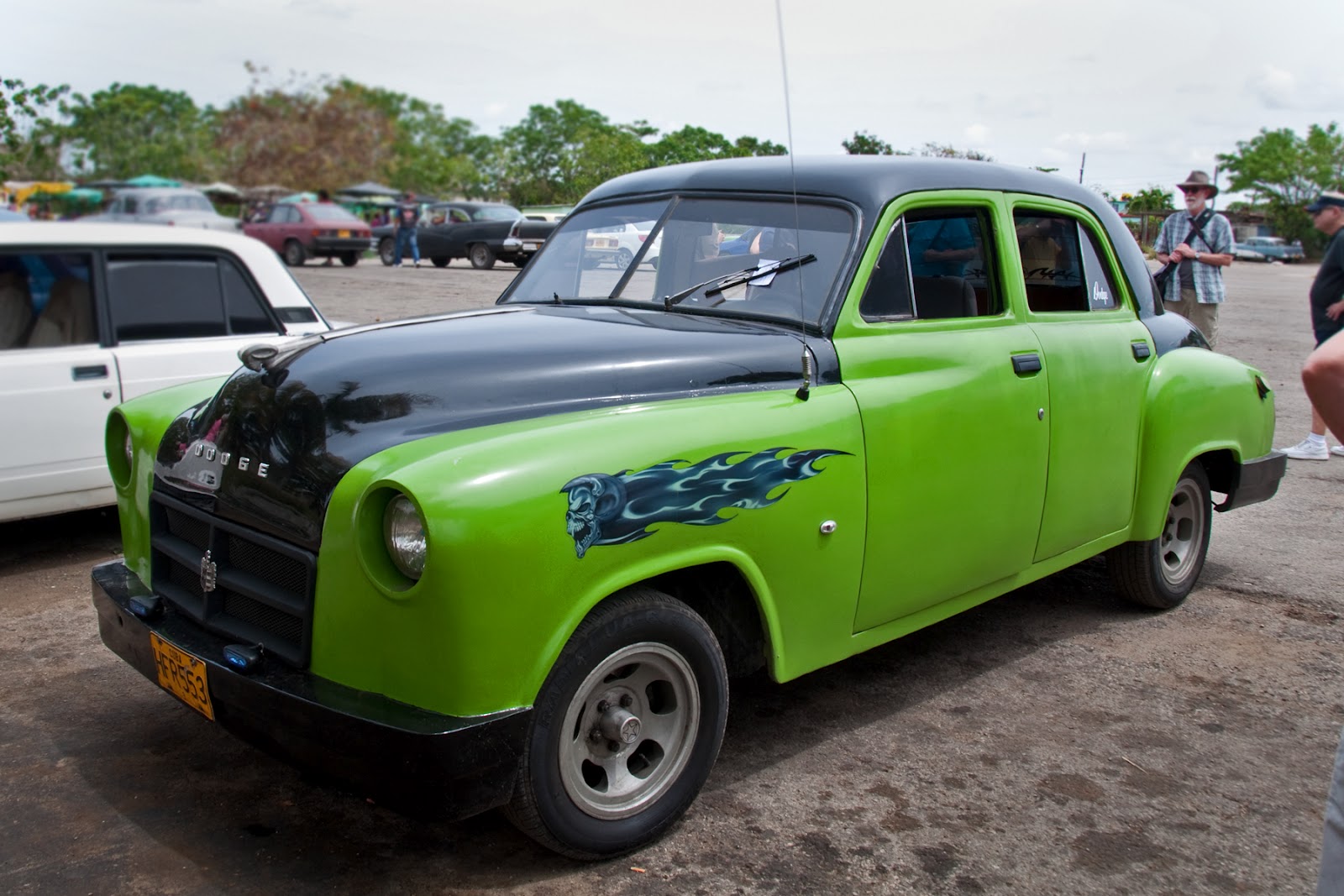
I'm going to take a little detour from the day-to-day tour blog, to talk about different modes of transportation in Cuba, and you can't talk about transportation in Cuba without mentioning the large number of pre-revolution era (1960 and older) American cars that are still on the roads. They are everywhere, and some of them are in pretty good shape!
Of course, not all of them are in such good condition, but they're still on the road -- sometimes it seems, held together with bubblegum and duct tape, but they're running none the less!
And they're not all American, or even cars...
as evidenced by this Harley Davidson...
and this 1937 (I believe) Morris Ten, although I'm not sure what's up with those weird wheels!


You might wonder how Cubans, whose incomes are minuscule compared to American salaries, can afford to put fuel in these gas guzzlers, especially when gas is over $6 a gallon. And with the embargo still in place, how do they get the parts needed to keep them going? Well, the Cuban people are very resourceful, and most, if not all, of those cars have had their engines and transmissions replaced with modern, diesel engines and drive trains from European and Asian rental cars that have reached 100K miles and are no longer rented to tourists. 


Also, all of these vehicles are used as taxis, one of the many enterprising activities that lots of Cubans engage in to make money. In fact, our tour guide, José, whose job in tourism provides the largest part of the family's support, has bought a '54 Chevy station wagon, which he and family members are "rejuvenating" with new parts to turn into a taxi, so it will bring much needed income to the family. 


I know...  just about now you're thinking, "But isn't Cuba a socialist country? How can there be entrepreneurism in such a place?" Well, the answer is very complicated (a phrase José is fond of using all the time), and I will explain more on the Cuban economy in a later post, but for now, I want to get back to the modes of transportation in Cuba...


A lot of people (mostly tourists) get around in these funny little CoCoTaxis, which Sam tells me, are run on small motorcycle (or lawn mower) engines.
However, we saw many more of this type of three wheeled taxi.
We also saw many merchants selling their goods on carts like these.
Although there were some scooters around, horses and horse drawn carriages were much more common, especially in small towns and rural areas.
Sometimes, the transportation has alternative uses, too.
And then, of course there is always the occasional old bicycle.
As far as mass transit goes, there aren't very many trains in Cuba. There are tracks, but since the Soviets left about twenty years ago, the Cubans have been unable to get parts to repair and maintain the trains.
There are buses, but they are old and very, very crowded. We were advised that tourists should not to use them. 
Most Cubans get around by "hitching" a ride, for a small fee, on any vehicle that comes along.

Needless to say, we felt extremely lucky to be riding in our new brand new, air conditioned Chinese tour bus!


Note: To view enlarged photos, just click on one of them and you will see a slide show of all photos in this post. Click the X in upper right hand corner of the slide show to return to the blog.