Friday, May 25, 2012

Cuban Tour: Day 1


As I previously posted, Sam and I chose to go to Cuba legally, and therefore, with a tour group that possesses the special license the US government requires for US citizens to travel there. Road Scholar (formerly Elderhostel) does a really good job of fulfilling the requirements of an educational, people-to-people, cultural experience while keeping the tour interesting, if not exhausting. Everyday was filled with so many activities, and so much information, that I will be hard pressed to remember it all! I will try to recall, through my photos, what we did each day, and hopefully, a little of what we learned about Cuba and its people.

First, we met with all of the other tour members the night before we left for Havana, at a hotel near the Miami Airport. There, we had an informational meeting, received our visas, special licenses, and our plane tickets. Early the next morning, we were shuttled to MIA, checked in, proceeded through security, and got on our plane for the most expensive less-than-one hour flight I've ever been on. It's only 90 miles from MIA to HAV, but according to our tickets, it was a $400 fare!

Every experience we had in Cuba was unique, including collecting our baggage at the baggage claim area at HAV. Along with our suitcases on the revolving track, there were dozens of oddly shaped packages, wrapped in lime green and hot pink "saran wrap," filled with who knows what, and several obvious items, like flat screen TVs, wrapped in cardboard and duck tape. This is how many Cuban-Americans support their family members back in Cuba. They arrive with huge, stuffed suitcases, and those weird looking plastic blobs, and then return to the US with nothing. It seems like an expensive way to ship things, but I guess it's the only way to be assured they will be delivered to family members. (Our guide, José, told us a story about some Americans he met on a tour, who sent him flea medication to be used on the stray dogs in Havana. When the package arrived, the boxes inside were empty, and he likes to imagine that whoever stole the contents is using it as eye drops!)

We left the airport in our air conditioned Chinese tour bus, and wasted no time getting started on our tour experiences. First stop: Plaza de la Revolución.
Plaza de la Revolución, or Revolution Square, was actually built during Batista's rule, and was called Plaza Civica. It was finished just before the revolution took place in 1959, and the name was changed. 

The main feature of the square is the José Martí Memorial. Martí is probably Cuba's most beloved national hero, and we saw statues of him everywhere we went. He was a leader in Cuba's fight for independence from Spain in the 1800s, and was killed in that struggle.

We also got some of our first glimpses of the famous 1950s (and older) American cars, but I will have more on that subject later...
Everywhere we went there were billboards and signs reminding everyone of the revolution. Some of them do have pictures of Fidel Castro, but generally, he does not allow images of himself, and there are no statues of him. This sign near the square reminds us it has been 53 years since the revolution, and it shows a young Fidel riding victoriously into Havana with Camilo Cienfuegos, a fellow revolutionary, who was killed later in a plane crash.
After our quick visit to the square, we headed to the Cementerio de Cristóbal Colón, or the Colon Cemetery, where  1 million people have been buried. It is packed with elaborate Italian white marble memorials and mausoleums, including a very large and symbolic memorial to the firefighters who lost their lives in a warehouse fire in 1890.
Apparently, this guy on the memorial represents betrayal. The company that owned the warehouse did not disclose to the fire department that there were explosive materials inside, so they weren't expecting the explosion that killed the firefighters.

Our cemetery guide pointed out this particular grave to draw our attention to the fine work done on some of these. The draped cloth on this memorial looks almost like soft linen.
The most famous grave site in the cemetery is that of La Milagrosa. Amelia Goyri de Adot and her son died when she gave birth to him in 1901. As was the custom, the baby was buried with her, at her feet, but it is said that when she was exhumed 3 years later, her body was intact and the baby was in her arms. 
For over a hundred years, pilgrims have come to her grave and asked for miracles. Many people believe she helped them and they bring marble "cards" to thank her.
This is the main chapel in the center of the cemetery.
Luckily, there were no services while we were there, so we were able to go inside the chapel.
Our guide at the cemetery was a very knowledgeable and friendly Cuban named Andreas, who spoke very good English and looked a little like a famous American...
When I asked him if people ever tell him he looks like our President, he said, "Yes, but thank goodness I don't have his problems!"


When we left the cemetery, it had gotten really warm, and we were very pleased to be dropped off at our first lunch stop, Restaurante la Torre, at the top of a 36 story building, with incredible birds eye views of Havana and the sea.

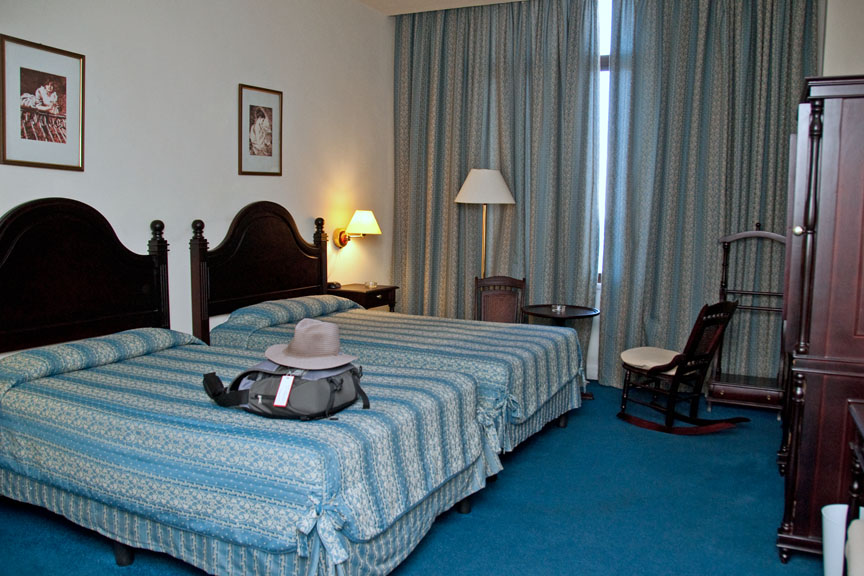
The building with two towers, left of center in the last photo, is the Hotel Nacional, where we stayed for four nights. After our lovely lunch, we arrived at the hotel, received our welcoming Mojito, and checked into our room, which was quite nice. The Nacional was built in 1930, and although it is a bit tired, it is still a beautiful hotel, and we had nice view from our 4th floor room.
That first evening, we had family style dinner at the hotel, on an outdoor covered patio, with our fellow tour members and peacocks squawking in the background. Afterwards, Sam and I sat outside, me with a daiquiri, and he with some 7 year old Cuban rum and a cigar, listening to live music, enjoying the Cuban breeze, and thinking how lucky are we?!

Note: To view enlarged photos, just click on one of them and you will see a slide show of all photos in this post. Click the X in upper right hand corner of the slide show to return to the blog. Also, in case you hadn't noticed, any type within the post that is a different color than white, can be clicked on and it will link you either to a video Sam has posted, or another webpage with more information.

Friday, May 18, 2012

¡CUBA!

A little over 2 weeks ago, Sam and I returned to the US after spending a week on what is a forbidden island for most Americans -- Cuba! 

It's true, Americans are not allowed to legally "vacation" in the land of Fidel Castro and Ché Guevara. It is possible, however, to get a special license to visit for educational, cultural, people-to-people interaction purposes. And of course, there is always the illegal option of first traveling to another country, like Canada or Mexico, then flying to Havana from there. Apparently lots of Americans do it that way. If the US Treasury Department finds out, there can be a heavy fine, but I'm not sure how many US citizens have been caught, especially since the Cuban customs agents generally do not stamp US passports for that reason. (How considerate of them, but I wanted the prized mark in my passport, so I requested it!)

Being the law-abiding citizens that we are, we took the legal route, and went with a tour company called Road Scholar (previously known as Elder Hostel). This is probably the best way to see Cuba the first time, but now, having done it, I would feel pretty comfortable going on our own if we ever went back. 

Cuba and the US have no banking relationship, so American credit cards and ATMs don't work. It is necessary to carry all of the money you will need in cash, which makes going with a tour company that covers all your hotels, transportation, and most of your meals, very convenient. The trade off is, you have very little control over where you go and what you do. Luckily, Road Scholar is very good at what they do, and other than not having enough free time to ourselves, we really didn't have any complaints about the program. We saw and did way more than we ever would have done by ourselves in a week! And although we usually avoid other Americans when we travel to foreign places, some of our fellow tour members turned out to be very interesting, and I think we may have made some good friends -- including a couple from Sacramento!

Because the license that allowed us to travel in Cuba required that we spend ALL of our time in cultural, people-to-people activities, our days were filled with lectures, musical performances, visits to Cuban homes, museums, a school for the arts, craft and book fairs, and numerous other buildings, memorials, and town squares. Even the time spend riding in our air conditioned bus was educational and entertaining. During our short visit, we met a lot of Cubans, saw a lot of the countryside, and a few of the cities, including Havana, Cienfuegos, Trinidad, and Santa Clara. We learned a lot, and had a wonderful time!

As usual, I have hundreds and hundreds of photos to comb through and edit, and Sam has hours of video he shot. In the next few weeks, I would like to take you on a little tour of Cuba with photos and videos, and hopefully, you will learn something you didn't know about a country that is incredibly beautiful, and whose people are resilient, resourceful, and proud. And you will find, as our amazing Cuban tour guide José liked to say, "Cuba is complicated!"

Thursday, December 1, 2011

Yosemite!

We've been home now for almost a month, so I'd better finish this trip blog while my memory is still fairly fresh, and before the holidays take over and I can't remember anything!

The last destination on our five week journey was a place I have been to many times in my lifetime, and is still one of the most awe-inspiring places I have ever seen: Yosemite National Park. 

Our last night was spent on the eastern side of the Sierras, in a tiny town called Lee Vining, California, just outside of the eastern entrance to the park. As we climbed to over 9500 feet of elevation on Highway 120, we came to a small body of mirror-like water called Ellery Lake, and the excitement began to mount.
Ellery Lake
Before long, we were in the Yosemite Valley, looking at some of the most majestic granite rock formations on earth! 
El Capitan

Half Dome

We drove around the park, stopping to shoot photos of sites like Bridal Veil Falls and the famous Tunnel View overlook.
Bridal Veil Falls

Wawona Tunnel View Overlook
Although we didn't take very many pictures of ourselves on our trip, we couldn't resist setting the self-timer on Sam's camera and getting this classic shot.


Before heading out of Yosemite, we stopped at Sentinel Beach, along the Merced River, to have a picnic lunch with El Capitan towering above us. The sun was warm on our backs as we sat at one of the picnic tables, munching on our crackers, cheese, and fruit, when a woman approached us and asked if we minded sharing our table with her and her husband. Of course, we said yes, and struck up a very enjoyable conversation with Heather and Dennis Fardy of Australia!

Sentinel Beach, with El Capitan in the background.
Turns out, they were also both recently retired and traveling across the US and Canada, however, they were beginning the eighth week of their TEN week trip! We exchanged comments about the various places we had been to, and although they have four children, they were tiny bit envious that we have two grandchildren. 

When it was time to go, I took a photo of the two of them and promised to send it to Heather's email address, which I did, and I am happy to say we have written back and forth a couple of times since. Looks like we now have some friends down under, too! Apparently, their home is on the northern beaches in Newport, near Sydney, with a balcony over looking the Pacific Ocean. They have invited us to visit them, should we ever make our way to Australia. I must admit, it does make the thought of that long flight much more appealing!